AI Pricing: What's the True AI Cost for Businesses in 2026?


Updated on September 8, 2026
AI costs are consuming IT budgets at light speed, with AI-native app spend growing nearly 400% for large enterprises in 2025, according to Zylo's 2026 SaaS Management Index. That spend growth isn’t expected to stop anytime soon. Gartner predicts that global AI software spend will reach $454M by the end of 2026, a 60.2% increase over 2025. In 2027, that figure is expected to increase another 40.8%.
For many organizations today, the pressing AI cost question is: what are we already spending on AI tools, agents, and AI-premium software? Often, that question goes unanswered because no one has visibility into where it all goes.
This guide answers that question with real enterprise spend data, then covers the pricing models that determine your bill, the factors that quietly inflate it, and how to budget for it.
The Short Answer: What AI Costs in 2026
AI costs in 2026 span two structures: predictable per-seat subscriptions and variable usage-based billing. A single AI seat from a major vendor runs about $20 to $30 per user per month, while usage-based tools bill by tokens, conversations, or actions, which makes the total harder to predict.
The table below shows published prices for commonly used AI tools as of August 2026. AI pricing changes often, so confirm current rates before you budget.
These AI prices only illustrate part of the overall cost. AI can be an additional cost per-seat and/or by usage or outcome. For example, the Microsoft 365 Copilot add-on only applies if you already pay for a qualifying M365 plan. Salesforce Agentforce also requires a subscription to access but with outcome/agent-based costs on top.
It’s easy to see how the all-in cost of an AI-enabled employee can grow quickly. Multiply that across thousands of seats, and it becomes the largest variance in your IT budget.
What Enterprises Actually Spend on AI
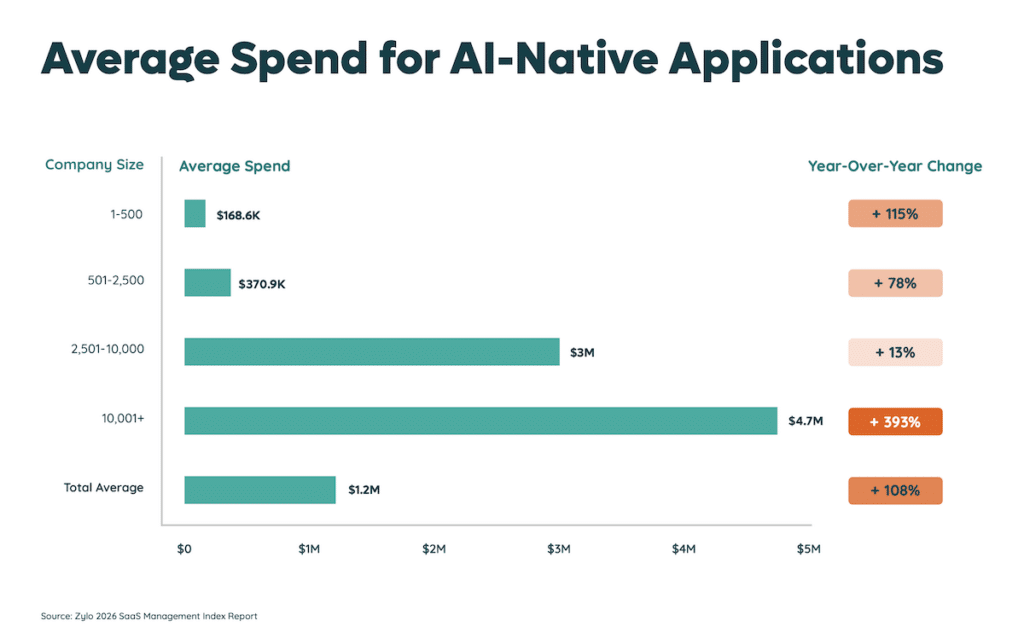
According to Zylo's 2026 SaaS Management Index, AI-native application spend averages $4.7M annually for large enterprises. AI has become a material line item in about two budget cycles, with costs rising faster than they can be governed. That pace is what makes AI spend hard to plan for, and it climbs sharply with company size:
AI tools now sit at the top of expense reports. ChatGPT is the most-expensed application by transaction count in Zylo's dataset, and eight of the 50 most-expensed applications (16%) are AI-native. The concentration of AI in expensed purchases signals that a large share of AI spend enters through individual employees and corporate cards rather than procurement.
For finance and procurement, projecting AI spend is more difficult than seat-based software, since it’s unpredictable. Basing this year’s budget on last year’s spend may vastly underestimate costs if adoption continues to rise. The larger the organization, the steeper the miss.
The AI Pricing Models That Determine Your Bill
Knowing which pricing model a tool uses tells you whether its cost is predictable or variable, and where to put your controls. Most enterprise AI spend runs through four pricing models:
- Per-seat subscriptions (and AI-premium SKU uplifts)
- Usage-based and token pricing
- Tiered and hybrid models
- Outcome- and agent-based pricing
Per-Seat Subscriptions (and AI-Premium SKU Uplifts)
Per-seat pricing charges a fixed fee per user, per month, the same structure traditional SaaS has always used. Microsoft 365 Copilot and Claude Team both price this way, and many established vendors now layer an AI-premium tier on top of the base license. Per-seat pricing is the easiest model to forecast.
Still, the AI uplift can push your effective cost per employee well above the base subscription, especially when the AI tier is bundled into a renewal you can't opt out of. For most enterprises, per-seat AI is the line item that's easiest to approve and easiest to overbuy, because a predictable price makes it simple to add seats faster than adoption justifies.
Usage-Based and Token Pricing
Usage-based pricing charges for what you consume: tokens processed, API calls made, or minutes used. Frontier model APIs from Anthropic, OpenAI, and Google price this way, metering every input and output token. This model has the lowest entry cost and the least predictable bill, because spend rises with activity and rarely comes with built-in caps. That makes consumption-based pricing the hardest structure to budget for once adoption scales.
Tiered and Hybrid Models
Tiered pricing sells access in escalating packages (Basic, Pro, Enterprise), while hybrid pricing combines a fixed subscription with usage-based charges on top. Salesforce and Zendesk increasingly layer usage fees onto per-seat contracts, and a growing share of AI vendors now run hybrid models. Hybrid pricing is the trickiest to forecast, because your invoice moves with both your seat count and your consumption, and the two rarely move together.
Outcome- and Agent-Based Pricing
Outcome- and agent-based pricing charges per result or per AI agent rather than per human user: a price per conversation, resolution, or agent deployed. Salesforce Agentforce prices this way, billing by the conversation or by consumption credits. Agent-based pricing can align cost with value when outcomes are well defined. However, it can also scale faster than headcount, because one team can deploy many agents without adding a single seat.
Which model fits your usage pattern? If your AI usage is variable or hard to predict, a usage-based or hybrid model offers the lowest entry cost, but it pairs best with spend caps, alerts, and regular consumption reviews. If your usage is steady and your team is standardized on a few tools, per-seat subscriptions give you the predictable bill that variable models can't. The rule of thumb: match the pricing model to how stable your usage is, and add controls wherever the bill can move on its own.
What Drives AI Costs Up (Including the Costs You Don't See)
AI costs increase due to shadow AI, overlapping tools, renewal premiums on AI features, usage overages, and governance and compliance costs.
Shadow AI Purchases
Shadow AI is the AI employees buy on their own, through expense reports and corporate cards, outside your standard procurement process. When employees buy shadow applications, they typically accept click-through terms. As a result, the price for those tools can be higher, since they weren’t negotiated as part of an enterprise agreement.
Overlapping AI Tools
When different departments buy overlapping AI tools independently, it duplicates spend and weakens your leverage with vendors. It's already visible in the data: generative AI is now the tenth most redundant application function in enterprise portfolios, with an average of seven such apps per organization. Seven overlapping AI tools mean seven contracts, seven renewals, and seven times paying for the same capability.
Renewal Premiums on AI Features
At renewal, vendors raise prices for AI functionality already baked into the contract, charging more for features you may not have chosen to adopt. It's part of a broader shift in how software vendors are repricing AI features, and it happens whether or not your usage justifies the increase.
Usage Overages and Commitment Shortfalls

Exceeding or falling short of your usage cost commitment—a block of tokens or credits purchased at a negotiated rate—is one of the most common reasons AI costs increase. Overages occur when usage exceeds your commitment, which costs more per unit than your negotiated price. In contrast, under-consuming means you overcommitted and you’re paying for capacity you didn’t use.
According to Zylo’s 2026 SaaS Management Index, a survey of 218 IT leaders found that 78% reported unexpected charges tied to consumption-based or AI pricing in the past year. This points to a structural problem where costs aren’t yet forecasted accurately or governed with guardrails.
Governance and Compliance Costs
Governance and compliance costs are the expenses of keeping AI use safe, auditable, and within regulation: data residency controls, audit and explainability tooling, legal review, and security monitoring. It impacts data within standalone AI tools as well as AI features inside software you already own.
For organizations in healthcare, finance, or government, compliance overhead can rival the license cost of the AI itself, because regulations like GDPR and HIPAA require controls that general-purpose AI tools don't include by default. These costs also tend to arrive after a tool is already in use, when pulling it back into compliance is more expensive than building the controls in from the start.
Buying vs. Building AI: Which Cost Question Are You Asking?
The difference between buying and building AI comes down to who does the work and who owns the bill. Buying means paying a vendor for finished AI tools, seats, and usage. Building means developing your own AI from scratch. Most enterprises are asking the buy question, and this guide answers it. But knowing your budget keeps a conversation about a single seat from turning into a debate about GPU clusters no one in the room owns.
Build Costs
Building AI requires hiring data scientists and machine learning engineers, provisioning GPU compute, and paying for tokens at production scale. A narrow internal tool built on an existing model might cost tens of thousands of dollars a year, while a custom, enterprise-wide system can run into the millions once you include infrastructure, talent, and ongoing tuning. These costs sit with engineering and data science, and needs monitoring, retraining, and maintenance for as long as it runs.
Buy Costs
Buying AI means paying a vendor for finished tools, seats, and usage: the per-seat subscriptions, AI-premium tiers, and consumption charges covered throughout this guide. These costs sit with IT, procurement, and finance, and scale with adoption. Most enterprises are managing the buy-side bill, so the rest of this guide stays there.
How to Budget for AI in 2026
Budgeting for AI in 2026 starts with a full inventory of the AI you already pay for, then a plan that treats predictable and variable costs differently. Follow these five steps:
- Inventory every AI tool and AI-enabled application you're paying for, including expensed and consumption-based purchases.
- Sort each line by pricing model: fixed per-seat, usage-based, hybrid, or agent-based.
- Forecast the fixed costs directly, and model the variable ones as a range from your adoption trends.
- Set guardrails on variable spend: usage caps, alerts, and monthly reviews.
- Match your commitment level to how stable your usage is and how centralized your buying is.
Two factors decide how conservative your AI budget should be: how variable your usage is, and how centralized your purchasing is.
Budget conservatively if your AI usage is variable or your purchasing is decentralized. Consumption-based tools, agent-based pricing, and heavy shadow AI adoption all make spend hard to predict. Build in headroom, set usage caps and alerts, and review consumption monthly rather than annually.
You can commit to fixed pricing if your usage is steady and your team is standardized on a few per-seat tools. Predictable, centralized per-seat adoption is the one case where annual commitments and multi-year discounts work in your favor rather than locking you into a bill you can't control.
For the variable half of your budget, model a range rather than a single figure. Take your current monthly consumption, project it against your expected adoption curve, and budget to the high end while setting alerts where spend would exceed your forecast. A range with guardrails helps prevent expensive overage costs.
Where AI Cost Visibility Breaks Down (and How to Fix It)
AI cost visibility breaks down because it hides in expense reports, SaaS contracts as AI add-ons, and renewals as price increases for AI features you may not be using. When AI spend is scattered, no single team sees the whole picture, and the total grows faster than anyone is tracking. Spend that starts as an individual subscription becomes an add-on at the next renewal or an accelerating consumption cost once the tool scales.
To gain visibility, you need to establish a system of record that connects AI spend, usage, and ownership across the portfolio. For instance,a SaaS and AI spend management tool like Zylo finds every AI tool—and their associated costs—and tracks consumption. When that data is centralized, all stakeholders know what’s going on and can take action as needed to keep spend in check.
Zylo's guide to managing AI costs across your software stack walks through the inventory, ownership, and governance steps in order.
Proactively Manage AI Costs with ZYlo
In 2026, AI spend is a portfolio-scale problem, doubling year over year and scattered across subscriptions, add-ons, and consumption charges. Left unmanaged, it compounds quietly until a renewal or an overage forces the conversation, and by then the money is already spent.
The next phase belongs to the organizations that treat AI spend as something to inventory and govern. The first step is the same one it's always been: find every AI tool you're paying for, then decide what it's worth. Zylo's AI and consumption cost management is built to make that first step possible.
On average, AI-native applications make up $4.7M in spend for large enterprises, according to Zylo's 2026 SaaS Management Index. For traditional SaaS with AI add-ons, like Salesforce, AI costs run ~$20-30 per user per month in addition to the base subscription. Consumption-based AI costs have no cap and fluctuate based on use, which can quickly exceed your budget.
AI is more expensive than most enterprises expect, largely because the cost fluctuates and is hard to predict. A single AI seat looks cheap at $20 to $30 per user per month. Still, total enterprise AI spend averages $1.2M a year and reaches $4.7M for organizations over 10,000 employees, per Zylo's 2026 SaaS Management Index. Most of that expense comes from many small purchases and consumption charges adding up across the portfolio.
Companies spend an average of $1.2M a year on AI-native applications, up 108% year over year, according to Zylo's 2026 SaaS Management Index. Spend scales with size: roughly $3M a year for organizations of 2,501 to 10,000 employees, and $4.7M for those above 10,000. ChatGPT is now the most-expensed application by transaction count, showing how much AI spend flows through individual employees.
Usage-based or hybrid pricing models are usually the best fit for variable usage, because they keep your entry cost low and charge only for what you consume. The tradeoff is a less predictable bill, so have governance in place, such as setting spend caps and usage alerts, and performing regular consumption reviews. If your usage is steady instead of variable, a fixed per-seat subscription will give you a more predictable cost.
AI is getting both cheaper and more expensive. Unit prices are dropping while total spend climbs, as organizations ramp up AI adoption and scale use across the business. Anthropic’s Opus rate has dropped from $15 to $5 per million input tokens. Meanwhile, Zylo’s 2026 SaaS management Index found that AI-native applications spend rose nearly 400% year over year for large enterprise organizations.